

Most CFOs meet AI as a stream of investment requests. Sales wants a pricing assistant, operations wants an agent for exception handling, HR wants help with workforce planning, and every proposal lands on the CFO's desk for approval. Meanwhile, in the CFO's own department, internal auditors still spend part of every control test hunting for the right version of an evidence file. AI in finance is often discussed as something finance judges, rarely as something finance uses.
That is a missed opportunity. The MetroMinds Library suggests that the finance function is one of the more practical places to start with AI, and one of the best places to prove that AI business cases can be measured honestly.
Finance is a small part of the AI portfolio
Of the 4,980 use cases in the MetroMinds Library, 191 sit in the finance and capital management capability. That is less than 4 percent. Most AI ideas target customer work, operations and supply chains, so the finance function rarely puts its own work forward when the portfolio is built.
Surveys outside the Library point the same way. When Gartner surveyed finance leaders in 2023, only 9 percent of finance organisations were scaling or using AI, against 20 percent of other administrative functions such as HR, legal and IT [1]. Adoption has grown since then. In Gartner's 2025 survey of 183 CFOs and senior finance leaders, 59 percent reported using AI in their finance function, roughly the same as the 58 percent of a year earlier [2].
The most common uses in that survey were knowledge management (49 percent of organisations using AI in finance), accounts payable automation (37 percent) and error and anomaly detection (34 percent) [2]. Those are useful, but they are mostly tools rather than a portfolio of decisions. The Library shows a wider set of options.
Where the finance use cases are
Inside finance, the Library groups use cases into five areas. Tax and internal audit is the largest, with 77 use cases. Treasury and cash management follows with 55, then financial planning and analysis with 29, investment and M&A with 21 and accounting and reporting with 9.

The feasibility scores are what stand out in that chart. Finance use cases average 3.58 on a scale of 1 to 5, against 3.29 for all other use cases in the Library. More than half of them (53 percent) score 4 or 5, compared with 47 percent across the Library. Tax and internal audit, the largest group, also has the highest average feasibility within finance at 3.75.
Why finance work suits AI so well
Three features of finance work explain the higher feasibility. The first is that the work is already documented. Controls, policies, tax rules and audit methodologies exist in writing, often in controlled libraries with version history. AI that searches, compares or summarises has something solid to work with.
The second is that the work is logged. Finance systems record who did what and when, which makes it far easier to measure a baseline. You know how many control tests ran last year, how many tax objections came in and how long the forecast cycle took. In many other functions, that baseline has to be estimated.
The third is that decision rights are clear. In a well-run finance function, it is obvious who approves a journal, signs off a test or releases a payment. That makes it easier to design AI that prepares the work while a named person keeps the decision, which in turn lowers the governance effort.
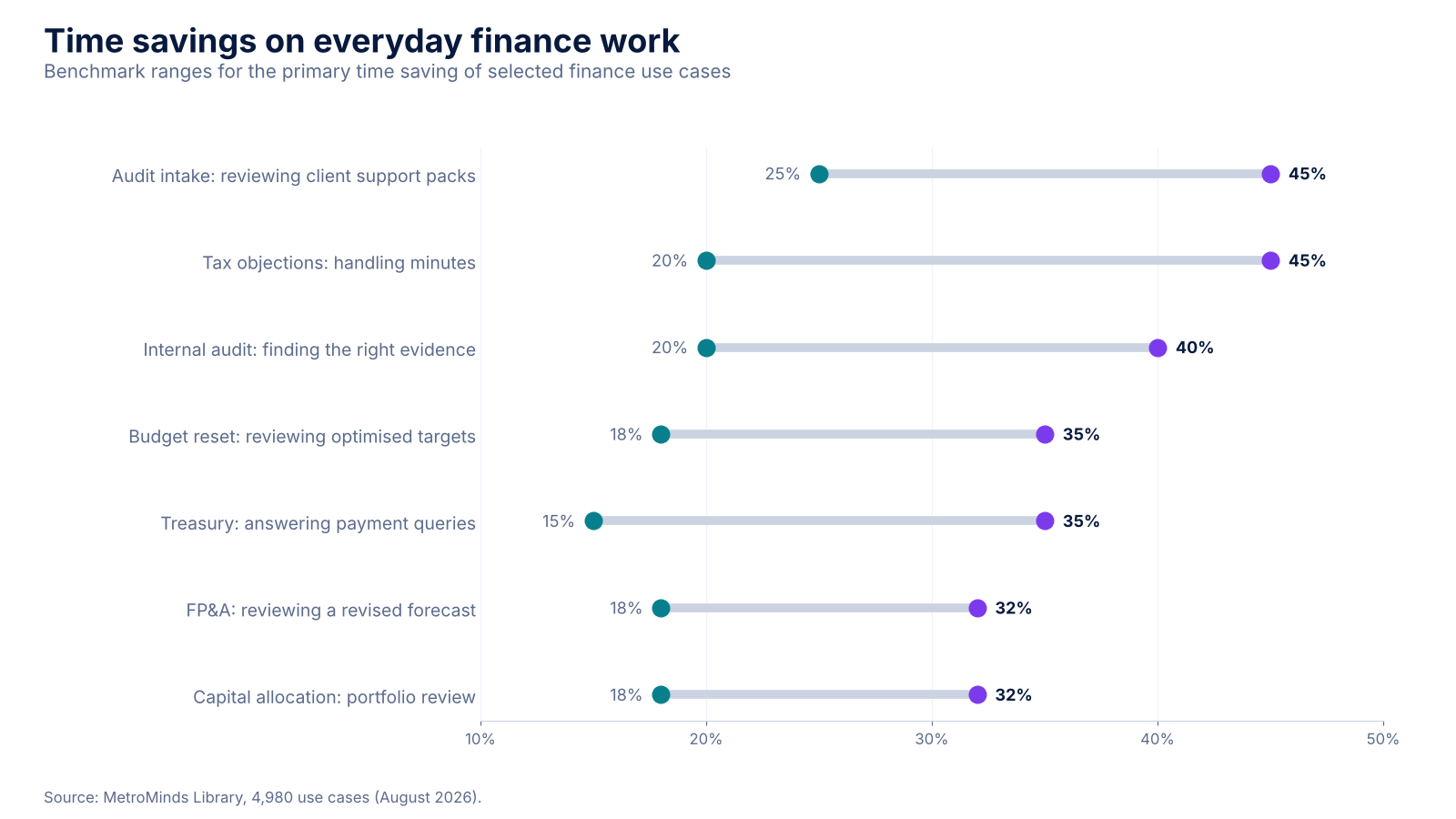
The Library's reflect this. The time savings for typical finance tasks are solid, with midpoints between 25 and 35 percent for the examples below.
What a finance business case looks like in practice
Because finance owns the data that most business cases need, such as volumes, hourly costs and headcount, it can build its own AI business cases with unusual precision. The example below uses the evidence search use case from the box above.
That last point matters. Released hours only become savings when someone decides how to use them. Our article on when saved time actually turns into money looks at that question in more detail.
Where to start, and where to be careful
Within finance, the Library points to a sensible order. Tax and internal audit combines the most use cases with the highest feasibility. Evidence search, objection handling and audit intake are document-heavy, well logged and have clear decision owners. They are good first candidates.
Financial planning and analysis comes next. Use cases that help an analyst rework a forecast between cycles, or test budget targets against constraints, score well on feasibility. They also give the CFO a direct view of how AI changes the quality of the numbers that leadership relies on.
Treasury deserves more care. Its average feasibility is the lowest in finance at 3.35. Payments and liquidity work is time-critical and connected to banks, counterparties and settlement windows, so integration and control requirements are higher. That does not make treasury use cases a bad idea. It means they belong later in the sequence, once the team has experience with governance and monitoring.
Gartner's 2025 survey adds a useful warning about expectations. Most respondents (91 percent) reported low or moderate impact at first, and Gartner noted that the biggest impacts come once AI reaches production [2]. A finance function that starts small should therefore plan for a learning period and measure carefully from the beginning.
Finance as the reference case
The strongest argument for starting in finance is not the size of the savings. It is the example it sets. A finance function that runs its own AI use cases with measured baselines, explicit scope and adoption factors, and an honest review after go-live gains the credibility to ask the same of everyone else.
It also learns first-hand where business cases go wrong. A CFO who has seen how quickly an adoption factor of 70% becomes 50% in practice will read the next proposal from operations very differently. The finance team becomes the place where the organisation's standards for AI business cases are tested, and then shared.
A few questions can help you decide whether your finance function is ready to play that role.
- Which of our finance processes have the best logged baseline: volumes, minutes per item and cost?
- Where in tax, audit or planning do people spend the most time searching for or checking information?
- Who owns each decision in those processes, and would they keep that decision if AI prepared the work?
- What will we do with the released hours, and who has agreed that?
How MetroMinds supports the finance function
In MetroMinds you can filter the Library by business function and capability, so the finance team sees its own 191 use cases with benchmark ranges, feasibility and workforce impact. Selected use cases move into a portfolio, where each business case is built from your own volumes and costs, with scope, adoption and confidence factors made explicit.
The same portfolio view then shows the finance use cases alongside the proposals from other departments. That way, the standard the finance team applies to itself becomes the standard for the whole AI portfolio.
Want to see the finance use cases that fit your organisation? Book a demo
Sources
- Gartner, "Gartner Says Most Finance Organizations Lag Other Functions in AI Implementation", press release, 7 November 2023.
- Gartner, "Gartner Survey Shows Finance AI Adoption Remains Steady in 2025", press release, 18 November 2025.
- MetroMinds Library, 4,980 AI use cases with benchmark ranges based on real-world implementations, August 2026.


