
Human oversight.
Name competent people with the authority to oversee each high-risk system.
MetroMinds analyses your application portfolio to find where AI is used, including AI built into vendor software, and records each system in an AI register aligned with the EU AI Act.
Every system in the register records what the EU AI Act asks you to know:
 GovernanceAI registerDemo environment
| AI system | Application / vendor | Purpose | Role | Risk category | Annex III area | Owner | Status | Last review |
|---|---|---|---|---|---|---|---|---|
| Credit decline reason codes | LoanDesk Origination Fenwick Systems | Explain credit declines to applicants | Deployer | High risk | Creditworthiness | Head of Credit Risk | In review | 12 Sep 2026 |
| Candidate ranking in recruitment platform | TalentFlow Recruit Orvia Software | Rank applicants for open vacancies | Deployer | High risk | Employment | HR Director | Approved | 3 Sep 2026 |
| Mortgage affordability pre-check | HomeLend Portal In-house | Pre-assess affordability before a mortgage offer | Provider | High risk | Creditworthiness | Head of Mortgages | Draft | 28 Aug 2026 |
| Shift allocation assistant | WorkPlan Scheduler Orvia Software | Allocate contact centre shifts and tasks | Deployer | Under assessment | Employment | Head of Customer Operations | In review | 19 Sep 2026 |
The extra time is best used for the inventory. Classification depends on what each system is used for, and that starts with knowing where it is.

Much AI arrives without a project: a vendor release adds a ranking feature, a business tool switches on an assistant. MetroMinds analyses your application portfolio and flags where AI is present, so nothing stays outside the register.
The Annex III indication is a starting point for your experts, not a legal classification. Whether a system is high-risk depends on its intended purpose and how it is used.
Check one of your use casesGovernancePortfolio analysisDemo environment| Feature | AI domain | First Annex III indication |
|---|---|---|
| Candidate ranking Ranks applicants against the vacancy profile | Prediction | Employment |
| CV parsing Extracts work history and skills from CVs | Perception | Employment |
| Interview scheduling assistant Proposes interview slots to candidates | Conversational AI | — |
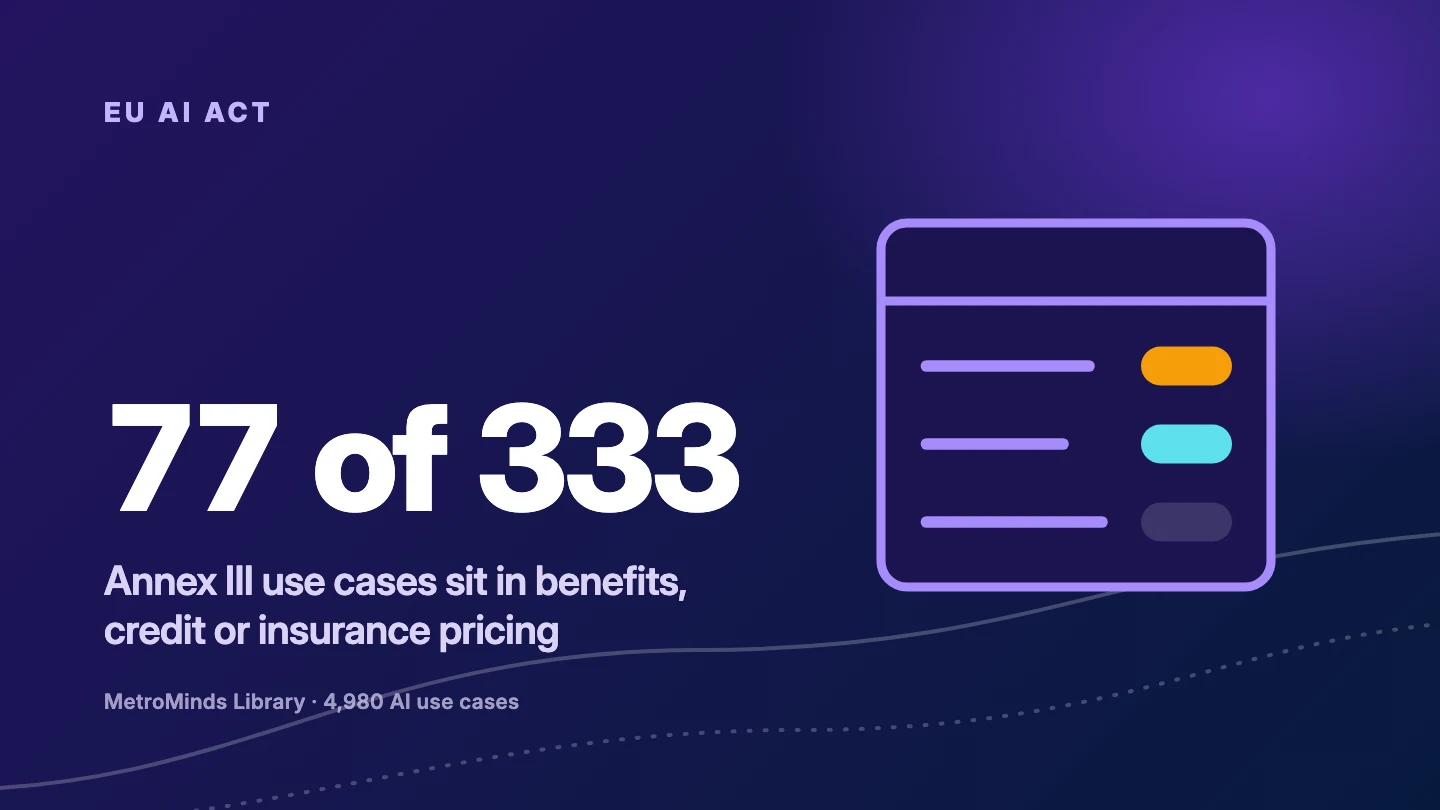
A first screen of the MetroMinds Library flags 333 of 4,980 use cases, about one in fifteen, that touch an area listed in Annex III. Most employment-related ones sit outside HR. Technically they look like the rest; what decides the classification is the intended purpose.
So the people who own high-risk AI are often operations managers who may never think of it as an HR or IT system.

Name competent people with the authority to oversee each high-risk system.
Monitor operation and keep automatically generated logs for at least six months.
Inform workers before first use, and inform people affected by decisions the system supports.
Run a fundamental rights impact assessment where the Act requires it, for example for credit scoring and public services.
GovernanceAI registerEntryDemo environment| Role | Oversight task | Authority |
|---|---|---|
| Recruitment Lead | Reviews every ranked shortlist before candidates are rejected | Can override or stop |
| HR Director | Accountable owner; approves changes to ranking criteria | Can suspend use |
| HR Analytics Specialist | Checks monthly for drift and adverse impact | Escalates to owner |
MetroMinds supports your compliance work. It does not replace legal advice.

You cannot classify or govern AI you have not found. One in fifteen Library use cases touches a high-risk area, and most of them sit outside HR and IT.
An AI register shows what you have. The EU AI Act deployer obligations are about how you run it: oversight, logs, monitoring, impact assessments and informing people.