

The CIO of a mid-sized manufacturer is preparing the annual AI review for the board. To make the list easier to read, she sorts the 48 initiatives by owner. Thirty-one belong to operations, planning and the plants. Six sit with finance and HR. Only four are owned by IT, and two of those are infrastructure upgrades that make the others possible. The AI portfolio she is presenting turns out to be, for the most part, an operations portfolio.
She is not unusual. When you look at where AI use cases actually land, the centre of gravity lies in the work of running the business. That has real consequences for AI portfolio management: who should own it, what IT's role becomes, and which skills the CIO needs to bring to the table. The data from the MetroMinds Library makes the pattern concrete, and it changes what a CIO should focus on.
Where AI use cases actually land
The MetroMinds Library holds 4,980 AI use cases, each linked to a . When you group them by the top level of the capability map, one block dominates. Operations and Delivery accounts for 1,971 use cases, or 40 percent of the total. Supply Chain and Sourcing adds another 11 percent. Together, half of all AI ideas concern the operational heart of the organisation.
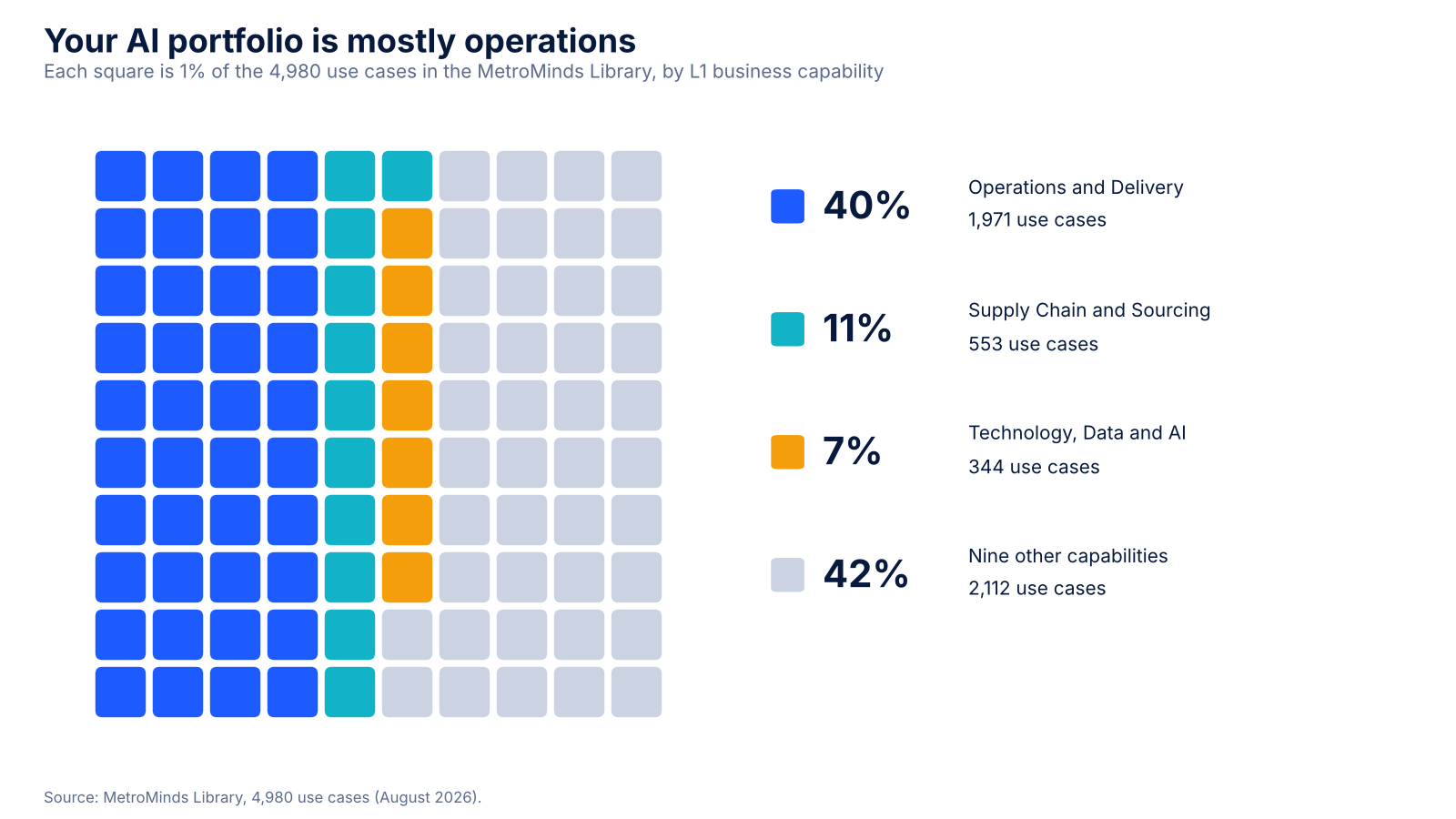
Technology, Data and AI, the capability closest to the traditional IT department, holds 7 percent. The remaining 42 percent is spread across nine other capabilities, from risk and compliance to customer growth, HR, finance and legal. If your AI portfolio is organised around IT projects, you are looking at less than a tenth of where AI will change work.
The weight of operations differs by sector. In manufacturing and in communications, close to 59 percent of the use cases sit in Operations and Delivery. In healthcare it is 52 percent and in energy and utilities 50 percent. In professional services the share is 21 percent and in media 26 percent, because more of their AI ideas concern customers and content. A CIO in a hospital or a utility should expect the portfolio to be dominated by operations; a CIO in a consultancy should expect a more mixed picture.
Spending and value do not always point the same way
Research outside the Library shows a similar pattern. Work by MIT's NANDA initiative, reported by Fortune in August 2025, found that "more than half of generative AI budgets are devoted to sales and marketing tools", while the biggest return came from back-office automation [1]. McKinsey's State of AI 2026 points the same way: respondents most often report cost reductions from AI in "supply chain management, service operations, and manufacturing" [2].
So the use cases with the clearest financial value are often the operational ones, while the visible budget goes elsewhere. For a CIO, that is an argument to look harder at the operations side of the portfolio, even when the most enthusiastic sponsors sit in marketing.
The work that IT still has to do
If most AI belongs to operations, it is tempting to conclude that IT can step back. The Library suggests the opposite. Every use case is scored on , including environment actionability: whether the systems where the work happens are set up for AI to act in them, through interfaces, permissions and controlled write access. For 93 percent of the operations use cases, that score is 1 or 2 out of 5.
In practice this means the AI can read data and prepare a recommendation, but a person still has to carry it out in the scheduling system, the maintenance planning tool or the patient administration system. Moving from "AI prepares" to "AI helps execute, under control" depends on integration, identity and access management, logging and data quality. Those are IT disciplines. The use cases belong to operations, but much of the work that makes them pay off belongs to you.
The same holds for agents. McKinsey reports that organisations most often scale AI agents "within IT, knowledge management, and software engineering" [2], close to home, where the systems are already accessible. Bringing agents into operations requires the integration groundwork that most operational environments do not yet have.
Changing IT's role in AI portfolio management
An operations-heavy portfolio asks for a different division of roles. The business owns the use case, the value and the change in daily work. IT owns the foundations that many use cases share, and makes sure each business case includes the cost of integration, security and running the AI. The portfolio manager, who can sit in a central AI office or in the business, keeps both sides honest.
This also makes the link with enterprise architecture explicit. When you map use cases to business capabilities, you can see which systems and data each capability depends on, and where several initiatives need the same foundation. We explore that connection in Where AI strategy loses money: the gap with enterprise architecture.
Questions for your next portfolio review
- What share of your AI initiatives belongs to operations and supply chain, and does the governance structure reflect that?
- Which operations use cases are waiting for the same integration or data foundation?
- Does every business case include the cost of integration, access control and running the AI, or only the cost of the model?
- Which use cases need the AI to act in a production system, and what has to be in place before you allow that?
- Is the COO a co-owner of the AI portfolio, or only a customer of it?
How MetroMinds supports an operations-heavy portfolio
MetroMinds links every use case to a business capability from L1 to L3, so you can see at a glance how much of your portfolio sits in operations, supply chain or elsewhere. The Technology Readiness profile of each use case shows integration and environment readiness, which helps you spot the shared foundations early. Business teams can contribute use cases themselves, while portfolio managers compare them on value and feasibility in one matrix.
Because the capability and workforce impact views show which parts of the organisation each use case changes, the CIO and the COO look at the same picture when they decide what moves from accepted to .
Want to see how your AI portfolio is spread across the business? Book a demo
Sources
- MIT NANDA, "The GenAI Divide: State of AI in Business 2025", as reported by Fortune in "MIT report: 95% of generative AI pilots at companies are failing", 18 August 2025.
- McKinsey & Company, "The state of AI in 2026: On the road to ROI", 25 August 2026.
- MetroMinds Library, 4,980 AI use cases with benchmark ranges based on real-world implementations, August 2026.


