

The operations director of a logistics company has three proposals on her desk, and all three are called AI agents. The first sends customers a status update when a delivery window is missed. The second drafts the apology email for the customer service team. The third works out a recovery plan across the carrier, the warehouse and the customer, and stages each step for approval. Each vendor uses the same word, but only one of the three actually describes an agent. Choosing the right agentic AI use cases starts with telling those apart.
That matters more than it sounds. An agent costs more to build, needs more controls and carries more risk than an assistant or a rules-based workflow. If a simpler solution does the job, the agent is an expensive way to get the same result. If the work really needs an agent and you pick something simpler, you get a tool that breaks at the first exception.
The MetroMinds Library scores 4,980 AI use cases on dozens of dimensions, and that data helps answer a practical question: how do you tell whether a use case really needs an agent, and what does it take to run one safely?
Why everything is suddenly called an agent
Agentic AI is the term of the moment, and vendors have noticed. Gartner calls the result "agent washing": the rebranding of existing products such as AI assistants, robotic process automation and chatbots as agentic AI. By its own estimate, only about 130 of the thousands of agentic AI vendors are real [1].
Gartner also predicts that over 40 percent of agentic AI projects will be cancelled by the end of 2027, because of escalating costs, unclear business value or inadequate risk controls [1]. Those three reasons are worth keeping in mind for the rest of this guide, because they are exactly what the Library data shows when you compare agentic use cases with the rest.
For you, the label on the proposal says very little. What matters is what the work demands, whether an agent is a good fit for it, and whether your technology can support it. Those are three separate questions, and the Library scores each of them.
What the Library says about agentic use cases
Of the 4,980 use cases in the MetroMinds Library, 600 sit in the agentic . They range from end-to-end workflow execution and multi-tool orchestration to multi-agent collaboration and robotics control. Every use case also carries portfolio scores for business value, feasibility and risk, so we can compare the agentic group with the other 4,380.
The result is a clear pattern. On business value, agentic use cases score almost the same as other AI use cases: 3.88 against 3.81 on a scale of 1 to 5. On feasibility they score much lower, 2.48 against 3.41. On risk they score higher, 4.06 against 3.79. In other words, agents promise roughly the same value as other AI, but they are harder to deliver and carry more risk while you do it.

The averages also hide a wide spread inside the agentic group. Use cases that combine robotic process automation with signal analysis score close to 5 on feasibility and well below average on risk. Multi-agent collaboration and robotics control sit at the other end, with feasibility scores close to 1. Almost a third of all agentic use cases (190 of 600) have the lowest possible feasibility score. "Agentic" covers anything from a sturdy automation with a smart trigger to a coordinated team of agents acting in physical systems.
Four questions that tell you whether you need an agent
To find out what really separates agentic use cases from the rest, we compared the review dimensions behind the scores. Each use case in the Library is assessed on more than twenty dimensions, from goal clarity and decision complexity to integration readiness and . Most dimensions differ only slightly between the two groups. A handful differ a lot, and they translate into four practical questions.
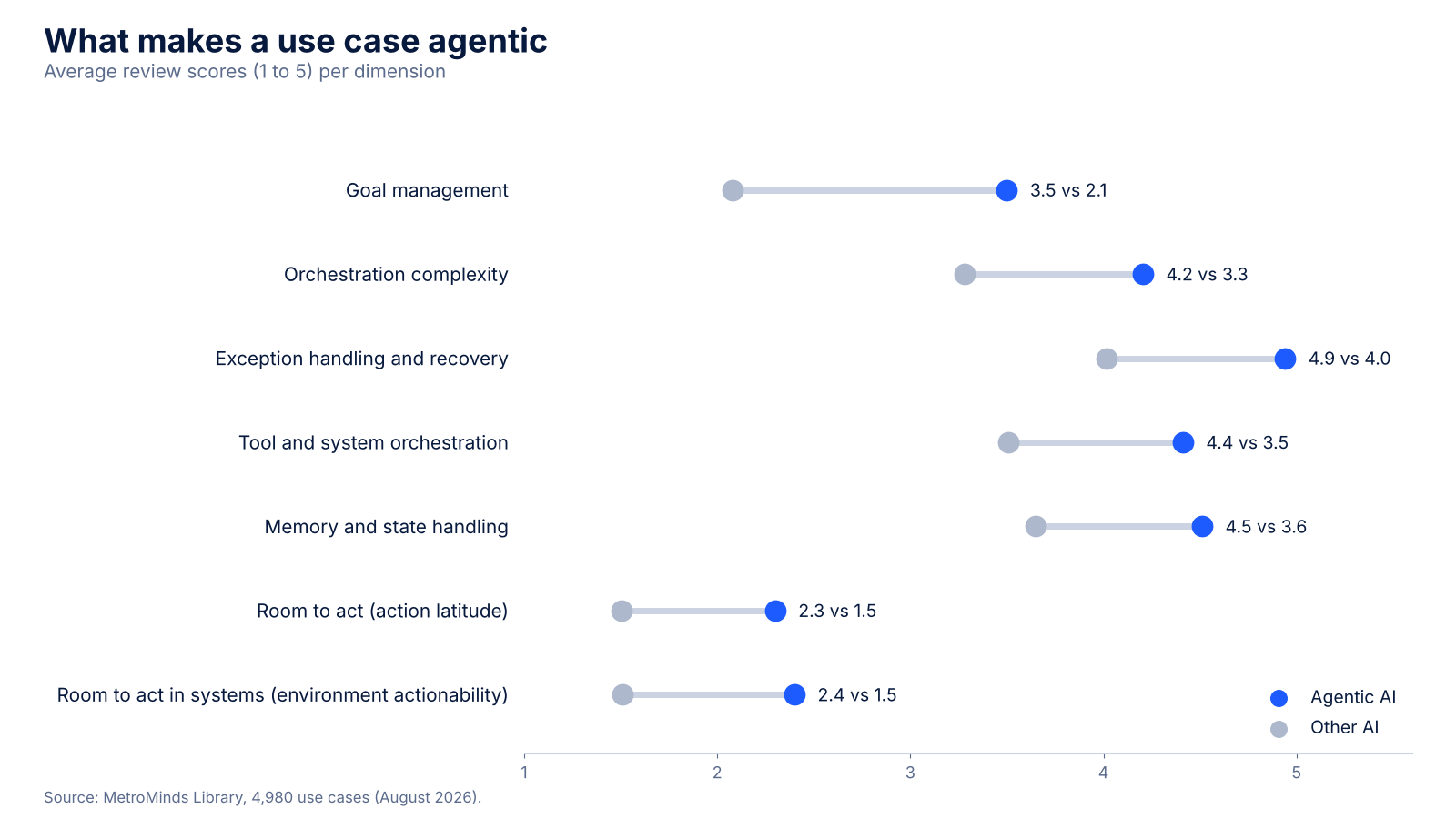
Does the work have a goal that needs managing over several steps?
Goal management shows the biggest gap of all: 3.5 for agentic use cases against 2.1 for the rest. An agent earns its keep when it has to keep a goal in view across several steps and adjust the plan when something changes, like getting a delayed shipment to the customer within the service commitment. If the work is one step, or always the same sequence, you do not need an agent to manage it.
Does it have to work across several tools and keep track of where it is?
Agentic use cases score 4.4 on tool and system orchestration against 3.5 for the rest, and 4.5 against 3.6 on memory and state handling. An agent that reads the tracking system, the carrier contract and the customer record, and remembers what it already tried, is doing something a single assistant cannot. When the work happens in one system, a well-designed workflow is usually enough.
Does it need to recover from exceptions on its own?
Exception handling and recovery scores 4.9 for agentic use cases against 4.0 for the rest. Be careful with this one, though. Messy input is common everywhere: the Library scores exceptions and ambiguity in the work itself at 4.5 for agentic use cases and 4.3 for the others. Exceptions on their own are no reason to build an agent. The question is whether the system has to decide what to do next when the exception occurs, or whether it can simply hand the case to a person.
How much room does it really have to act?
This is the question most proposals skip. We come back to it in the next section, because the Library gives a surprising answer.
If the answer to the first two questions is no, you probably need an assistant or an automated workflow, not an agent. Gartner's advice points the same way: start using AI agents "when decisions are needed", with "automation for routine workflows and assistants for simple retrieval" [1]. The AI company Anthropic gives developers similar advice in its guidance on building agents: find "the simplest solution possible", and only increase complexity when needed [2].
The agents that work are on a short leash
One finding in the data stands out. measures how much freedom the work gives the AI to act on its own. Across all 4,980 use cases in the Library, not a single one scores above 3 out of 5. For the 600 agentic use cases the average is 2.3, and 420 of them score 2. Environment actionability, which measures whether the surrounding systems allow an agent to act directly, tells the same story: 2.4 for agentic use cases and 1.5 for the rest.
In practice, the agentic use cases in the Library prepare, coordinate and stage actions, while people approve the actions that matter. The logistics use case above is typical. The agent may send a status update on its own, but a credit or a reroute waits for the coordinator. The record of each case shows who approved what and why an action was overridden.
That is good design rather than a lack of ambition. It is also where regulation is heading. For high-risk systems, the EU AI Act requires that people can oversee the system while it is in use, can decide not to use it or override its output, and can stop it through a "stop" button or a similar procedure [3]. Even outside the high-risk categories, those are sensible requirements for anything that acts on behalf of your organisation.
So the real design question for an agent is rarely whether it should act autonomously. It is which actions it may take alone, which need a person, and what evidence it must leave behind. A proposal that cannot answer that question is not ready for approval.
Is your organisation ready for the agents you want?
Fit is one half of the picture. The other half is whether your technology can support an agent: integration, data access, observability at runtime and safety controls. The Library scores both for every use case, which lets you place each one in one of four groups.
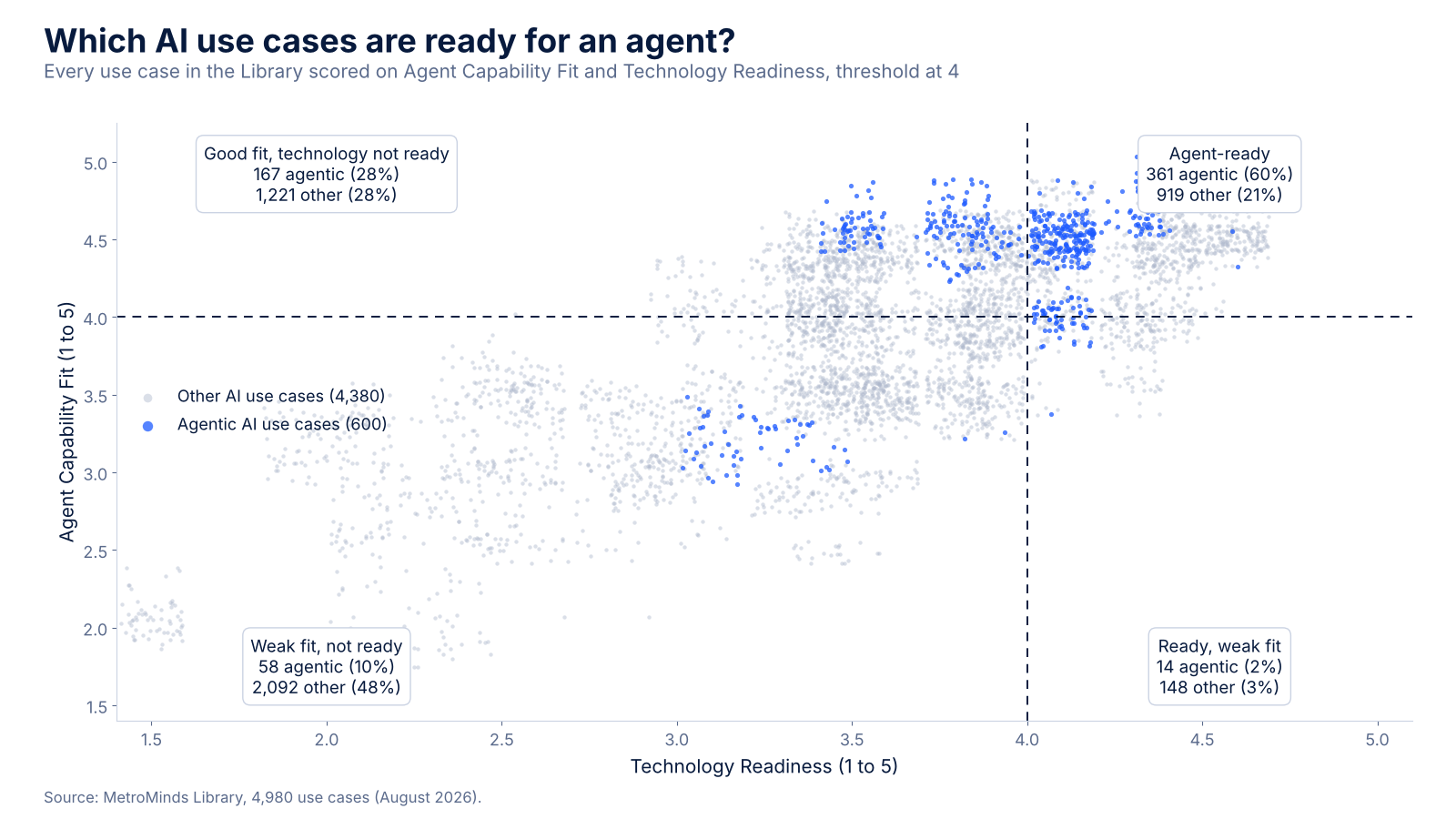
Sixty percent of the agentic use cases (361 of 600) score 4 or higher on both and . Another 28 percent are a good fit for an agent but lack the technology readiness. For those, the work is in integration, data and monitoring before the agent itself.
The more interesting finding sits outside the agentic group. Of the 4,380 other use cases, 919 (21 percent) are also agent-ready, even though nobody labelled them as agentic. Most of them come from three domains: AI trust, governance and engineering (298), optimisation (189) and prediction (172). Some of your best agent candidates may already be in your portfolio under a different name.
The opposite holds too. Almost half of the other use cases (2,092, or 48 percent) score below 4 on both scales. Turning those into agents because the vendor offers an agent version adds cost and risk without a clear gain.
What an agent does to your business case
Higher risk and lower feasibility have a price, and the business case should show it. Orchestration complexity, where a higher score means harder orchestration, averages 4.2 for agentic use cases against 3.3 for the rest. That shows up in build effort, testing and the cost of running and monitoring the agent once it is live.
Three adjustments make an agentic business case more honest. First, include the cost of the controls: approval rules, logging, monitoring and the time people spend reviewing staged actions. Second, apply a lower while the agent is new, because its behaviour in rare situations is still unproven. Third, start with a limited set of actions the agent may take alone, and widen that set only when the logs show it works.
The help here. An agentic use case can stay a candidate until its approval rules are defined, and move to accepted once the business owner agrees which actions need a person. It only moves to approved for execution when the technology readiness is in place. If a vendor cannot show how the agent can be stopped or overridden, on hold with a clear reason is a perfectly good outcome.
Agents also tend to overlap with other initiatives, because they work across a whole workflow rather than one task. We wrote about that in our guide to double counted AI savings.
Questions to ask before you approve an agent
- Does the work need a goal managed across several steps, or is it one step or a fixed sequence?
- How many systems does the agent need to read from and act in, and does it need to remember what it already tried?
- When an exception occurs, does the system need to decide the next step, or can it hand the case to a person?
- Which actions may the agent take alone, which need approval, and who approves them?
- Can people see what the agent is doing while it runs, override it and stop it?
- Does the business case include the cost of controls, review time and monitoring?
- Would an assistant or an automated workflow deliver most of the value at a lower cost?
How MetroMinds helps you choose
MetroMinds scores every use case in its Library on three profiles: what the work demands (), how well AI agents fit it (Agent Capability Fit) and how mature the technology is (Technology Readiness). You see those profiles per use case and for your portfolio as a whole, so you can spot where demand and technology diverge before any budget goes in.
You can compare what your portfolio demands with how ready your organisation is, using the AI Readiness Scan. And because the portfolio business case works with benchmark ranges and scope, adoption and confidence factors, an agentic use case gets a number you can defend rather than a vendor's best case. To see where your organisation stands today, you can start with the free AI Readiness Snapshot.
Want to see which of your use cases are ready for an agent? Book a demo
Sources
- Gartner, "Gartner Predicts Over 40% of Agentic AI Projects Will Be Canceled by End of 2027", press release, 25 June 2025.
- Anthropic, "Building effective agents", 19 December 2024.
- European Union, Regulation (EU) 2024/1689 (Artificial Intelligence Act), Article 14: Human oversight.
- MetroMinds Library, 4,980 AI use cases with benchmark ranges based on real-world implementations, August 2026.


