

The head of payments operations at a mid-sized European bank has just watched a convincing demo. An agent picks up a failed payment, checks the settlement window, pulls the screening result, proposes a fix and closes the case. The vendor says it can be live in a quarter. Then the model risk team asks two questions nobody in the demo answered: what exactly is the agent allowed to do on its own, and how will the bank see afterwards what it did? That moment is where most AI agents in banking either become a controlled production service or quietly stay a pilot.
This article is about that moment. We look at what the MetroMinds Library shows about agentic use cases in banking, where they are ready and where they are not, and which decisions a bank needs to take before an agent touches a live process.
What the Library shows about AI agents in banking
The MetroMinds Library holds 81 use cases for banking. Ten of them are agentic: the AI plans steps, coordinates work or acts within limits, rather than only answering a question or drafting a document. They cover loan servicing, client onboarding, underwriting exceptions, payment controls and even cash handling in a vault.
On paper, these ten are a strong match for agents. Their average is 4.4 out of 5. The work has many exceptions, depends on several systems and needs a memory of what happened earlier in the case, which is exactly what agents are built for.
The feasibility picture is different. The agentic banking use cases score 2.6 on feasibility, against 3.5 for all banking use cases in the Library. Their risk score is also slightly higher, at 4.0 against 3.8. In other words, the cases where an agent fits best are also the ones that are hardest to put into production safely.
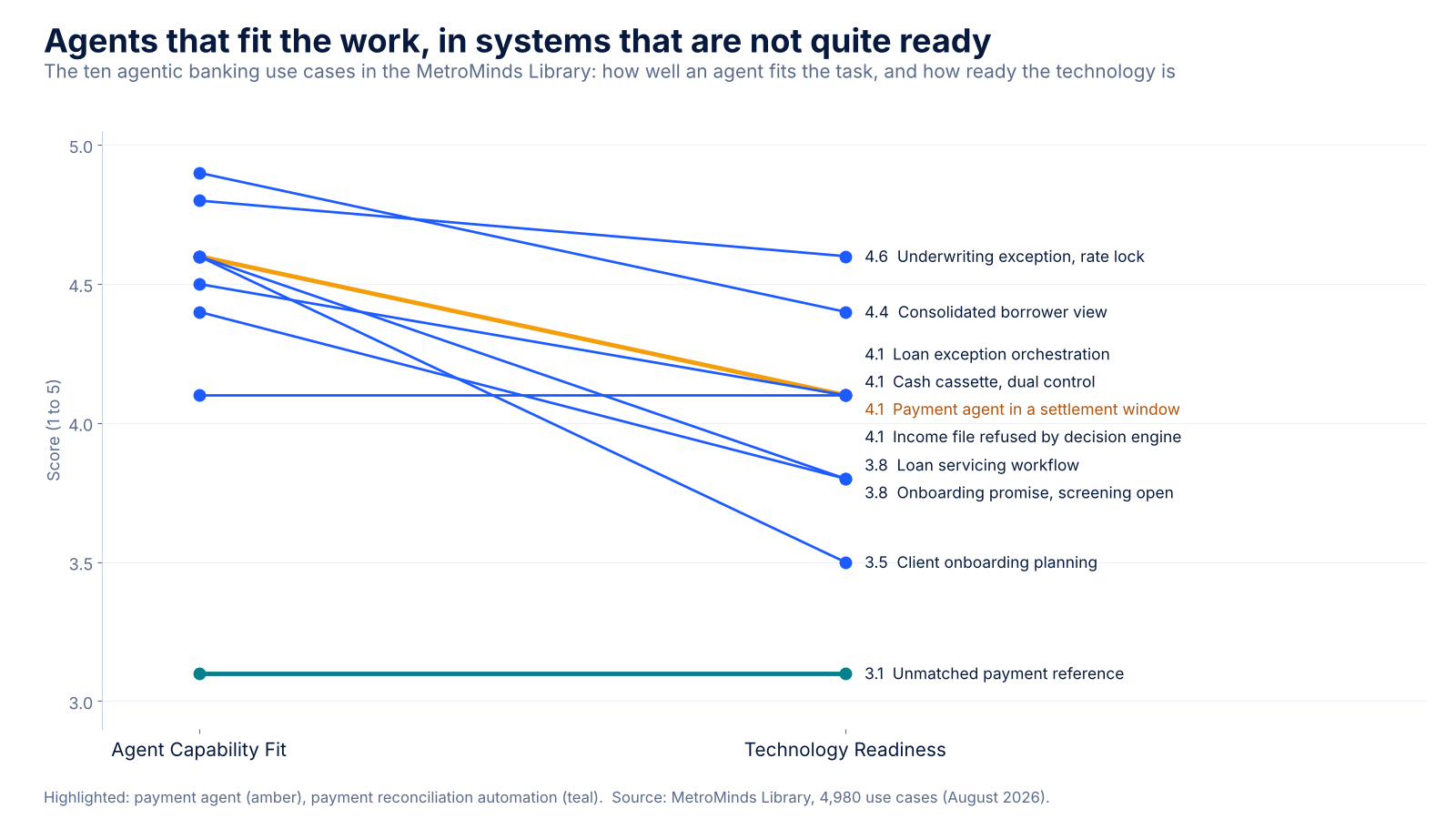
The chart shows the gap case by case. For eight of the ten, is lower than agent fit. Client onboarding planning drops the furthest, from 4.6 to 3.5. One case stands out at the bottom: matching an unmatched reference on an overnight payment run. It has the lowest agent fit of the group, 3.1, but the highest feasibility, a full 5. It is closer to rule-based workflow automation than to a real agent, and that is precisely why it is the easiest one to deliver.
Production readiness sits around the agent, not inside it
When a bank asks whether an agent is ready, the conversation often turns to the model: is it accurate, does it hallucinate, can it explain itself. The Library suggests the harder questions are about the environment the agent works in.
For the ten agentic banking use cases, integration readiness and data access both average 4.4. , the ability to see what an agent did and why, averages 4.3. Those are workable starting points. The two weaker dimensions are safety and policy enforcement, at 3.9, and environment actionability, at 2.4. The last one measures how far the surrounding systems let an agent take action in a controlled way. Six of the ten cases score only 2 on it.
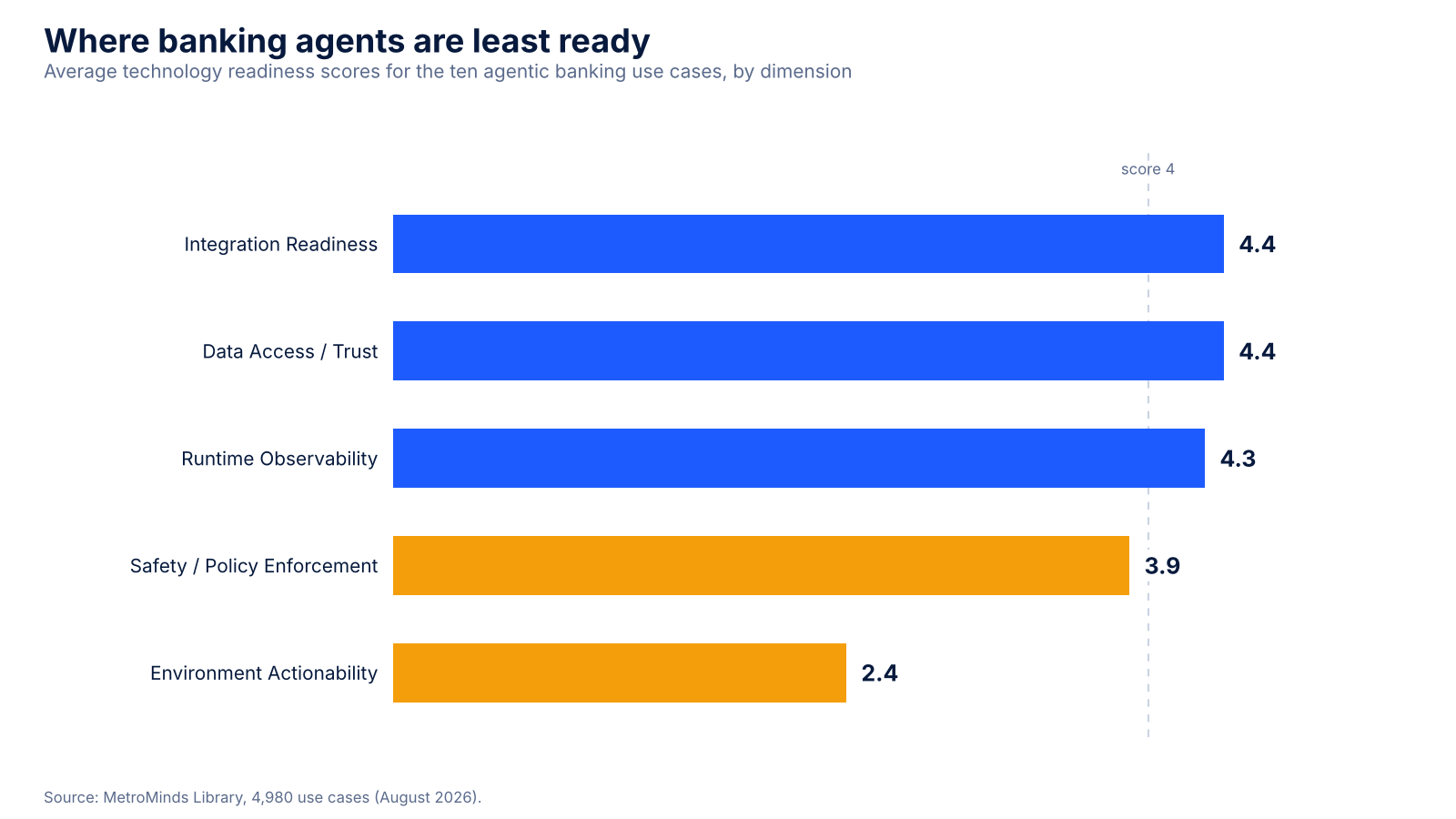
This matches what most banks experience. Core banking and payment platforms were built for people and for batch processes, with approval steps designed around human roles. An agent can read from them well. Letting it write to them, with the right limits, rollback options and audit trail, takes far more work than building the agent itself.
Decide how much latitude the agent gets
The most important design decision is how far the agent may go on its own. The Library scores this as . For seven of the ten agentic banking use cases, it is 2 out of 5: the agent prepares, checks and proposes, and a named person decides. None of the ten scores above 3.
That is in line with practice across the sector. In the joint survey by the Bank of England and the Financial Conduct Authority, "only 2% of use cases have fully autonomous decision-making" [1]. Most automated use cases still keep a person involved for critical or ambiguous decisions.
The difference between an agent that prepares and an agent that executes is easy to underestimate. The box below compares both versions of the payment agent.
Know where the regulatory lines are
Some agentic use cases in banking sit close to activities that regulation treats as high-risk. The EU AI Act lists "AI systems intended to be used to evaluate the creditworthiness of natural persons or establish their credit score" as high-risk in [2]. An agent that assembles an underwriting exception file or decides when an income document is good enough is working right next to that line, even when a person signs off.
Understanding the technology is the other gap. In the same Bank of England and FCA survey, "46% of respondent firms reported having only 'partial understanding'" of the AI technologies they use [1]. For agents that act across several systems, that gap matters more, because a failure can travel further before someone notices it.
So before a bank moves an agent into production, it is worth classifying each use case explicitly: does it touch a high-risk activity, which controls does that require, and who in the bank owns the outcome?
Five questions before an agent touches a live process
- Which actions may the agent take without a person, and which actions must it only propose?
- Can the payment or core banking platform enforce those limits itself, so the agent cannot work around them?
- Can operations and audit replay what the agent saw, what it proposed and who accepted it?
- Does the use case touch a high-risk activity under the EU AI Act, such as creditworthiness?
- Which simpler automation would deliver most of the value with less risk, like the payment reconciliation case above?
Banks that answer these questions early tend to move faster later, because the model risk and compliance review has fewer surprises. Banks that skip them usually find out at the approval stage, when the agent is already built.
How MetroMinds helps banks choose their agents
Every use case in the MetroMinds Library carries three separate profiles: , Agent Capability Fit and Technology Readiness. That makes it easy to see where an agent fits the work but the environment is not ready, and where a simpler form of automation is the better choice. Within a portfolio, you compare what the use cases demand with what your organisation can deliver today.
Use cases move through clear statuses, from candidate to accepted and , and a use case cannot be put on hold or rejected without a recorded reason. For a bank, that gives model risk and compliance a traceable view of why each agent went ahead or did not.
For a broader look at when a use case needs an agent at all, read our guide Does this use case really need an AI agent? If compliance is your starting point, see where AI really saves time in banking compliance.
Want to see the readiness profile of the agents on your shortlist? Book a demo
Sources
- Bank of England and Financial Conduct Authority, "Artificial intelligence in UK financial services 2024", 21 November 2024.
- European Union, Regulation (EU) 2024/1689 (Artificial Intelligence Act), Annex III, point 5(b), 2024.
- MetroMinds Library, 4,980 AI use cases with benchmark ranges based on real-world implementations, August 2026.


