

The proposal for AI in government permit handling is ready for the municipal board. The programme manager has a solid story: officials spend less time checking incomplete applications, citizens get answers sooner and the backlog finally shrinks. Then the board member responsible for finance asks the question every public sector business case runs into: how many jobs does this save? The honest answer is none, because nobody plans to reduce the team. And suddenly the business case looks empty.
Public organisations face this problem everywhere. The standard way of valuing AI comes from the private sector, where saved time is translated into lower costs. In government, saved time usually goes back into the work: shorter waiting times, fewer errors and more attention for complex cases.
A case that explains the backlog first
Before you can show that AI reduces a backlog, you need to understand where the backlog comes from. The use case below is a good example of AI that supports the public manager's judgement rather than replacing anyone.
What government AI use cases really promise
The MetroMinds Library holds 487 government use cases, spread evenly across six areas: public safety, human services, civil administration, regulatory agencies, defence, and tax and revenue. Each use case comes with based on real-world implementations, and most list more than one type of benefit.
When you look at the headline benefit, the picture seems to confirm the finance question. In 445 of the 487 government use cases, 91 percent, the first benefit is a saving in time or effort. Only 36 lead with faster answers or higher throughput for citizens.
But the headline is only part of the story. At the same time, 445 of the 487 use cases, again 91 percent, also list at least one benefit that is not about time: fewer errors and less rework, better quality, faster service or lower risk. Across all benefits listed, quality and rework account for 30 percent and speed and throughput for another 9 percent.
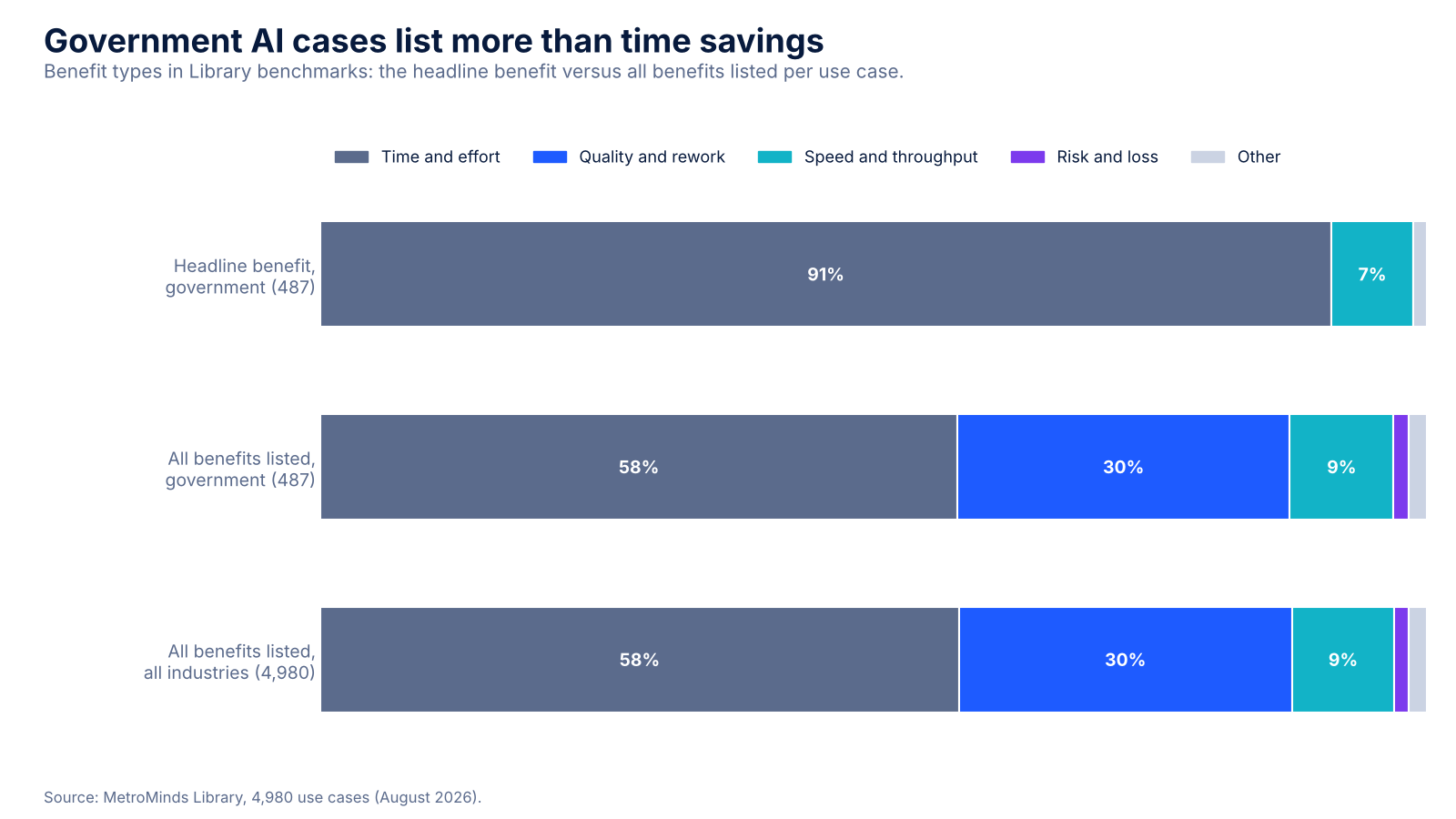
Notice that the profile of all benefits listed in government is almost identical to the profile across all industries. The difference is not in what AI does. It is in what a public organisation can do with the result.
Why the value gets lost in the business case
Most business case templates turn saved time into money through the cost of the hours involved. In the Library, 403 of the government use cases, or 83 percent, use that route as their default calculation. It works well when an organisation can reduce hours, stop hiring or cut agency spend. In government, those options are often limited or politically undesirable, so the euro figure looks theoretical and the other benefits never get a proper place.
A better approach starts from the outcome the organisation is accountable for. For a permit team that might be the share of decisions made within the legal deadline. For a benefits agency it could be the number of corrections after an objection. For a tax office it could be the time a taxpayer waits for an answer. The released capacity is then valued by what it does for that outcome.
Value beyond efficiency is well documented
International research supports this broader view of public value. In its report on AI in government, the OECD notes that "AI can help governments design and deliver more proactive and personalised public services" and that it "can bolster government accountability by enhancing the capacity for oversight and red-flagging potential fraud risks" [1]. Neither of those benefits fits neatly into a cost-saving calculation, yet both are central to what public organisations are for.
The same report also warns about bias, transparency and data quality. That is a reminder that value and risk belong in the same conversation, especially when AI touches decisions about citizens.
Benefits decisions need extra care
Some government use cases fall under the strictest rules of the EU AI Act. lists as high-risk the AI systems "intended to be used by public authorities or on behalf of public authorities to evaluate the eligibility of natural persons for essential public assistance benefits and services" [2]. For those systems, the business case has to account for oversight, documentation and logging from the start.
This is another reason not to sell government AI as a way to cut jobs. In high-risk areas, the people who review AI-prepared decisions are part of the legal design. Our article on who is accountable when AI prepares the decision looks at what that means for roles and responsibilities.
Questions for your next government AI business case
- Which public outcome is this use case meant to improve, and how do we measure it today?
- Where will the released hours go: backlog, deadlines, complex cases or service quality?
- Which non-time benefits in the benchmark, such as fewer errors or faster answers, can we measure from existing data?
- Does the use case touch decisions about eligibility or benefits, and what does that mean under the EU AI Act?
- Can we explain the value to the board without promising job cuts we do not intend to make?
For a closer look at when saved hours do turn into money, read when saved time actually turns into money.
How MetroMinds supports public sector AI portfolios
MetroMinds lets you filter the Library on government and its subsectors, so you start from use cases that match your services. Each use case shows all its benefit types with benchmark ranges, not only the time saving, and the business case lets you adjust scope, adoption and confidence to your own situation.
In the portfolio, you can compare initiatives on value and feasibility, track them from candidate to and record why an initiative was put on hold or rejected. The workforce impact view shows how work changes for officials, which helps you explain to the board, the works council and citizens where the value comes from.
Want to see how government use cases look in your own portfolio? Book a demo
Sources
- OECD, "Governing with Artificial Intelligence: Are Governments Ready?", OECD Artificial Intelligence Papers, 2024.
- European Union, Regulation (EU) 2024/1689 (Artificial Intelligence Act), Annex III, point 5(a), Official Journal, 12 July 2024.
- MetroMinds Library, 4,980 AI use cases with benchmark ranges based on real-world implementations, August 2026.


